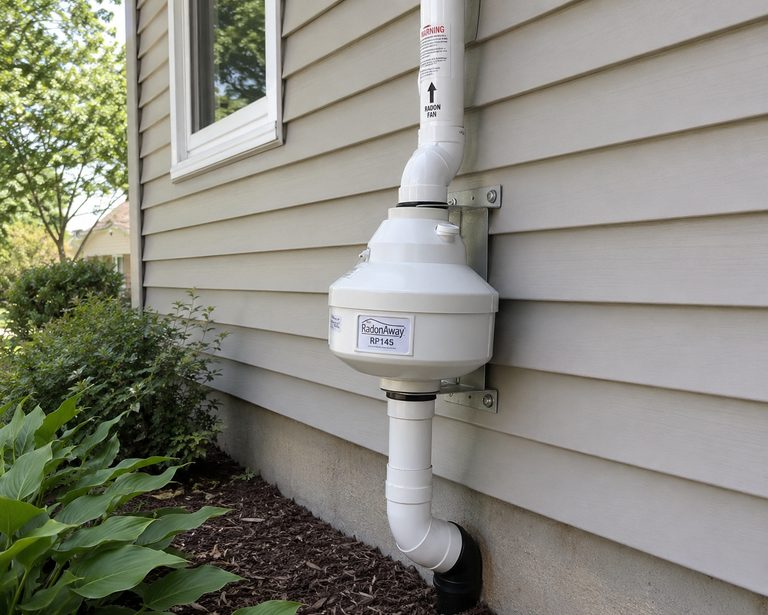
We seal Antioch crawl spaces under a heavy membrane and use a quiet inline fan to exhaust radon above the roofline before it enters your home.
Southeast Nashville's geology doesn't care how new the neighborhood is. Antioch is part of Davidson County — EPA Radon Zone 1, the highest-risk designation — and the limestone bedrock beneath the Mill Creek watershed contains trace uranium that decays into radon gas. That gas works upward through soil and fractured rock under every street from the Hickory Hollow area to the newest Cane Ridge cul-de-sacs.
The houses that filled Antioch between the 1990s and 2010s were built quickly and in volume. In crawl space homes from that era, we routinely find thin 6-mil builder plastic lying loose on the dirt — never sealed at the walls, never taped at the seams. Radon flows around it freely, then rises through floor penetrations, ductwork chases, and gaps at the band joist. Open foundation vents and unsealed crawl space doors add even more pathways.
The EPA-recognized solution for crawl space homes is sub-membrane depressurization. We replace that loose builder plastic with a heavy-duty vapor barrier sealed across the floor and up the foundation walls, set a suction point beneath the membrane, and connect it through PVC to a quiet inline radon fan that runs around the clock. Soil gas is pulled out from under the barrier and exhausted above the roofline instead of seeping into the house.
Every Antioch system includes a sealed 20-mil reinforced vapor barrier acting as the radon membrane, all seams and penetrations sealed, a properly placed suction pit, a low-watt inline fan rated for continuous use, exterior PVC routed and terminated above the roofline per EPA guidance, a system monitor so you can verify the fan is running, and post-install radon testing to confirm levels have dropped below 4 pCi/L.
Antioch crawl spaces tend to run humid — Mill Creek bottomland moisture plus open vents is a damp combination — so many homeowners pair radon work with full encapsulation. The same sealed membrane handles both jobs: it blocks ground moisture and serves as the radon barrier, making the combined project considerably cheaper than two separate ones. Existing encapsulations can be retrofitted with an active fan.
Cost depends on the footprint of the crawl space, how many suction points are needed to hold negative pressure under the membrane, whether usable encapsulation is already in place, and the exterior vent route on your home's elevation. We walk every Antioch crawl space in person before issuing a free written estimate.
We walk your Antioch crawl space, review any prior radon tests, and identify the right suction layout for your home.
Itemized scope and price, including any encapsulation work needed for the system to perform.
Membrane, suction pit, PVC routing, fan, and exterior termination — installed cleanly and code-aware.
We retest to confirm radon levels have dropped below the EPA action level and leave you with a working system monitor.
Yes. Antioch is part of Davidson County, which the EPA places in Radon Zone 1 — its highest-risk classification. The limestone geology under southeast Nashville produces radon everywhere from older Hickory Hollow-area streets to the newest Cane Ridge subdivisions, and only a test tells you where your home stands.
Not usually. Most builders in Antioch's boom years installed thin 6-mil plastic that was never sealed at the walls or seams — it slows moisture a little but does nothing to stop soil gas. Radon levels are set by the rock under the house, not the year on the permit.
It seals a heavy vapor barrier over the crawl space floor and walls, places a suction point beneath that membrane, and uses a continuously running inline fan to pull soil gas out from underneath and vent it above the roofline — so radon is exhausted outdoors instead of drifting up into your rooms.
No. Inline radon fans are engineered for continuous duty and run quietly — neighbors won't notice it, and from inside the home it's typically barely audible.
The inline fan is low-wattage. It runs continuously, but the effect on a typical Antioch power bill is modest — and the sealed membrane reduces the humidity load on your HVAC, which often offsets it.
We recommend both. A pre-install test establishes your baseline, and a post-install test after 24 hours of continuous fan operation verifies the system is holding levels below the EPA's 4 pCi/L action level.
Schedule a free crawl space evaluation. We'll walk the space, review any test results you have, and give you a clear plan.
Get My Free InspectionTell us a little about your home and we'll be in touch soon to schedule a no-pressure visit.
