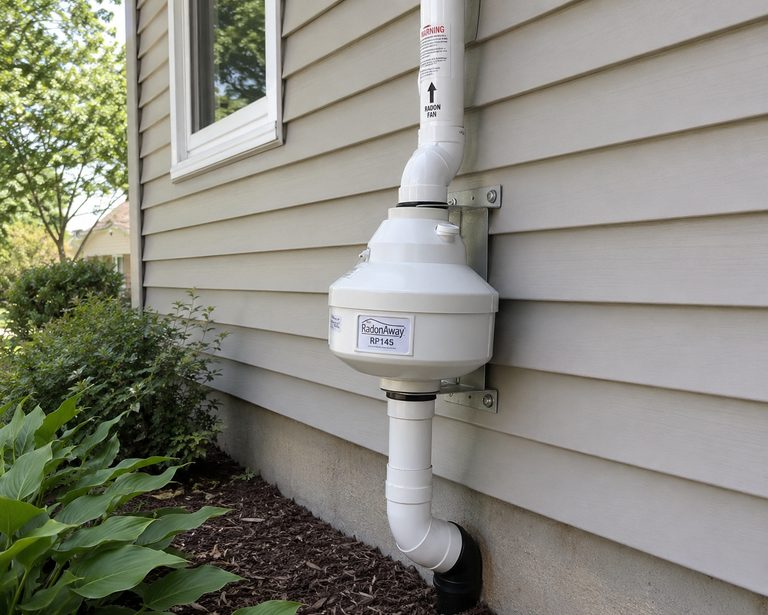
We seal Bellevue crawl spaces under a heavy membrane and vent radon above the roofline with a quiet inline fan — systems designed around hillside layouts.
Bellevue sits where the Harpeth River has carved through layers of Davidson County limestone, leaving the exposed ridges and bluffs that give the area its character. That same fractured limestone contains trace uranium that decays into radon gas, and the EPA classifies all of Davidson County as Radon Zone 1 — the highest-risk category. Two houses on the same ridge near Red Caboose Park can test very differently, which is why measurement matters more than assumptions.
Most of Bellevue was built between the 1970s and 1990s, when vented crawl spaces with bare dirt or thin loose plastic were standard practice. On hillside lots, split-level and walk-out designs put extra foundation surface directly against fractured rock — more contact area, more entry pathways. Radon moves up through unsealed crawl space floors, block-wall cores, plumbing penetrations, and the open vents that line so many Bellevue foundations.
For crawl space homes, the EPA-recognized fix is sub-membrane depressurization. A heavy-duty vapor barrier goes across the entire crawl space floor and up the foundation walls, sealed at every seam and pier. Beneath it we set a suction pit, connected by PVC to a quiet inline radon fan running continuously. On Bellevue's stepped, multi-elevation crawl spaces we map the suction layout so negative pressure holds under every section of the membrane, then vent the collected soil gas above the roofline.
Every Bellevue system includes a sealed 20-mil reinforced vapor barrier acting as the radon membrane, all seams and penetrations sealed, suction pits placed for your crawl space's elevation changes, a low-watt inline fan rated for continuous use, exterior PVC routed and terminated above the roofline per EPA guidance, a system monitor so you can verify the fan is operating, and post-install radon testing to confirm levels have dropped below 4 pCi/L.
Bellevue crawl spaces deal with more than gas — valley humidity and hillside runoff keep many of them damp year-round. A full encapsulation addresses the moisture, and the same sealed membrane becomes the radon barrier, so bundling the projects is the most cost-effective path. If your home is already encapsulated, we can add an active suction point and fan to the existing liner.
Pricing reflects the size and complexity of the crawl space — stepped hillside foundations sometimes need more than one suction point — plus whether encapsulation is already in place and how the vent stack routes up your home's exterior. Every estimate starts with a free in-person walk of your Bellevue crawl space and is delivered in writing.
We walk your Bellevue crawl space, note elevation changes and prior radon tests, and plan the suction layout your hillside home needs.
Itemized scope and price, including any encapsulation work needed for the system to perform.
Membrane, suction pit, PVC routing, fan, and exterior termination — installed cleanly and code-aware.
We retest to confirm radon levels have dropped below the EPA action level and leave you with a working system monitor.
Serious enough to test for. Bellevue is in Davidson County, an EPA Radon Zone 1 area — the highest-risk designation — and the exposed limestone ridges around the Harpeth River valley are exactly the kind of geology that produces elevated indoor radon. Readings vary house to house, even on the same street.
It can. Homes cut into hillsides often have more foundation surface in contact with fractured rock, and split-level or walk-out designs common in Bellevue's 1970s-90s neighborhoods create extra soil-contact zones where gas can enter. That's why we evaluate each home's layout before designing the system.
It's the standard EPA-recognized method for crawl space homes: a heavy vapor barrier sealed over the floor and up the walls, a suction pit beneath the membrane, and an inline fan that runs continuously, drawing soil gas from under the barrier and exhausting it above the roofline.
Rarely. Inline radon fans are designed for quiet continuous operation, and on most Bellevue installations the fan sits on the exterior run where it's barely audible indoors.
The fan is low-wattage, so the impact on your electric bill is modest. The sealed membrane also cuts the moisture load on your HVAC, which frequently offsets the fan's draw.
We retest after the fan has run continuously for at least 24 hours, verifying that levels have dropped below the EPA's 4 pCi/L action level. Periodic retesting every couple of years is a sensible habit in Zone 1 counties.
Schedule a free crawl space evaluation. We'll walk the space, review any test results you have, and give you a clear plan.
Get My Free InspectionTell us a little about your home and we'll be in touch soon to schedule a no-pressure visit.
