We install sub-membrane depressurization systems in Franklin crawl spaces — drawing soil gas out from under a sealed barrier and venting it above the roofline.
The EPA places all of Williamson County in Radon Zone 1, its highest-risk category. The limestone and dolomite bedrock beneath the Harpeth River valley contains trace uranium that decays into radon gas, which works its way up through soil and fractured rock into whatever sits above it. That geology runs under historic downtown Franklin just as surely as it runs under the newest phase of Westhaven — radon risk in Franklin is about the rock, not the neighborhood.
Franklin's housing spans more than a century, and each era has its own weak points. Pre-war homes near downtown often sit on vented crawl spaces with bare dirt floors and stone or brick foundations full of mortar gaps. The 1990s-to-2020s subdivisions around Cool Springs and Westhaven mostly got thin 6-mil builder plastic laid loose on the ground — unsealed at the walls and useless against soil gas. In both cases, radon enters through the crawl space floor, plumbing penetrations, and gaps at the sill.
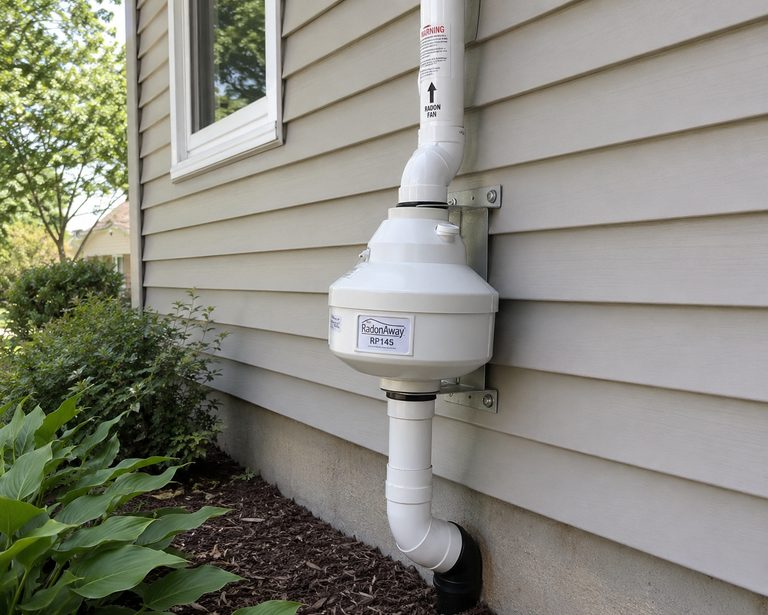
Sub-membrane depressurization is the EPA-recognized approach for crawl space homes. We install a heavy-duty sealed vapor barrier across the full crawl space floor and up the foundation walls, then place a suction point beneath the membrane. PVC piping connects it to a quiet inline radon fan that runs continuously, holding negative pressure under the barrier so soil gas is captured and exhausted above the roofline instead of seeping into the house.
Every Franklin system includes a sealed 20-mil reinforced vapor barrier serving as the radon membrane, all seams and penetrations sealed, a properly formed suction pit, a low-watt inline radon fan rated for continuous operation, exterior PVC routed thoughtfully — especially on historic-district homes — and terminated above the roofline per EPA guidance, a system monitor so you can verify performance at a glance, and post-install radon testing to confirm levels are below 4 pCi/L.
Franklin's humid summers make crawl space moisture a problem on its own, and the sealed membrane at the heart of a radon system is the same liner used in full encapsulation. Bundling the two means the liner you're paying for controls ground moisture and soil gas at once. If your Franklin home is already encapsulated, we can add a suction point and fan to activate the existing barrier.
Price depends on crawl space size, the suction layout needed to hold negative pressure under the membrane, whether encapsulation already exists, and the exterior vent route — which we plan carefully on older homes near downtown. We give a free written estimate after evaluating your Franklin crawl space in person.
We walk your Franklin crawl space, review any prior radon tests, and identify the right suction layout for your home.
Itemized scope and price, including any encapsulation work needed for the system to perform.
Membrane, suction pit, PVC routing, fan, and exterior termination — installed cleanly and code-aware.
We retest to confirm radon levels have dropped below the EPA action level and leave you with a working system monitor.
Williamson County is designated EPA Radon Zone 1 — the highest-risk category in the country. Franklin homes routinely test above the 4 pCi/L action level, whether they're pre-war houses near downtown or newer builds in Cool Springs and Westhaven. The only way to know your number is to test.
Yes. Radon levels are set by the limestone geology under the foundation, not the build date. Many newer Franklin subdivisions were finished with thin builder-grade plastic in the crawl space that was never sealed at the walls, which does little to stop soil gas.
Sub-membrane depressurization — the EPA-recognized method for crawl space homes. A sealed vapor barrier covers the floor and walls, a suction point sits beneath it, and a quiet inline fan continuously pulls soil gas out and vents it above the roofline.
Yes. On older homes we plan the exterior PVC route around the architecture, typically along a rear or side elevation, and we're careful with stone and brick foundations when sealing the membrane at the walls.
The inline fan is low-wattage and built for continuous duty, so the effect on a typical Franklin power bill is modest. The sealed membrane also cuts crawl space moisture, easing the load on your HVAC.
Test before installation to establish a baseline, then again after the fan has run continuously for at least 24 hours. The follow-up confirms the system is keeping levels under the EPA's 4 pCi/L action level.
Schedule a free crawl space evaluation. We'll walk the space, review any test results you have, and give you a clear plan.
Get My Free InspectionTell us a little about your home and we'll be in touch soon to schedule a no-pressure visit.
