We install sub-membrane depressurization systems in Goodlettsville crawl spaces — capturing soil gas under a sealed barrier and venting it above the roofline.
Goodlettsville is one of the few Middle Tennessee towns split between two counties — Davidson and Sumner — and the EPA puts both in Radon Zone 1, its highest-risk category. The rolling hills that give the town its character are built on fractured limestone, and those fractures act as natural channels for soil gas. From the historic ground around Mansker's Station to the neighborhoods behind Rivergate, the geology underfoot is the same, and so is the radon potential.
Most of Goodlettsville's housing went up between the 1960s and the 1990s, and a lot of it was built into hillsides — split-levels, walk-out basements with adjoining crawl spaces, and stepped foundations. These layouts often hide multiple crawl space zones at different elevations, each with bare dirt or loose, unsealed plastic on the floor. Radon moves up through those exposed floors and into the house via plumbing penetrations, sill gaps, open block cores in stem walls, and the transitions between foundation levels.
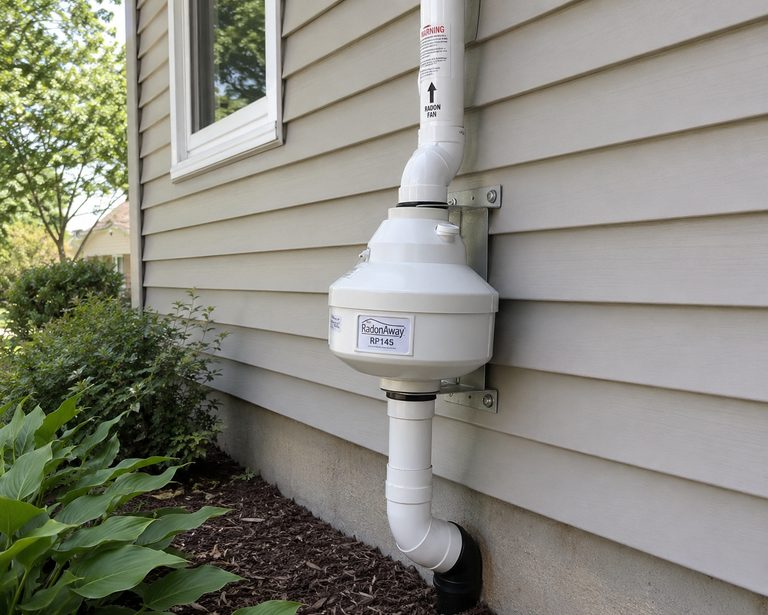
The EPA-recognized solution for crawl space homes is sub-membrane depressurization. We seal a heavy-duty vapor barrier across the entire crawl space floor and up the foundation walls — including across stepped sections, which take extra detailing in hillside homes. A suction point beneath the membrane connects through PVC to a quiet inline fan running continuously, pulling soil gas out from under the barrier and exhausting it above the roofline.
Our installs include a sealed 20-mil reinforced vapor barrier acting as the radon membrane, seams and penetrations fully sealed, suction pits placed where the sub-membrane airflow actually needs them, a low-watt inline radon fan rated for continuous duty, exterior PVC terminated above the roofline per EPA guidance, a system monitor you can check at a glance, and post-install radon testing to verify levels are below the 4 pCi/L action level.
Hillside crawl spaces in Goodlettsville tend to collect moisture as well as soil gas — water moves downslope, and the lowest crawl space zone takes the brunt. A full encapsulation uses the same sealed membrane the radon system requires, so combining the projects gets you moisture control and radon mitigation from a single liner. If you've already encapsulated, we can retrofit a suction point and fan to make the existing barrier an active system.
Pricing reflects the size and complexity of the crawl space — stepped hillside foundations sometimes need more than one suction point — plus whether encapsulation is already in place and how the exterior vent stack can be routed. We walk the space in person and put a free, itemized estimate in writing before any work is scheduled.
We walk your Goodlettsville crawl space, map any stepped zones, and review prior radon tests to plan the suction layout.
Itemized scope and price, including any encapsulation work needed for the system to perform.
Membrane, suction pit, PVC routing, fan, and exterior termination — installed cleanly and code-aware.
We retest to confirm radon levels have dropped below the EPA action level and leave you with a working system monitor.
Not for radon. Goodlettsville straddles the Davidson/Sumner county line, and both counties carry the EPA's Radon Zone 1 designation — the highest-risk category. Whether your home is closer to Rivergate or up toward the Sumner side, the limestone underneath behaves the same way.
The rolling hills around Goodlettsville are underlain by fractured limestone, and those fractures act like channels that move soil gas toward foundations. Many 1960s-90s homes here have stepped or split-level crawl spaces cut into the hillside, with bare dirt floors that give radon a direct route indoors.
Through sub-membrane depressurization. We seal a heavy vapor barrier over the crawl space floor and up the walls, install a suction point beneath the membrane, and connect it to a quiet inline fan that continuously draws soil gas out and exhausts it above the roofline.
Yes. Stepped and multi-zone crawl spaces are common in Goodlettsville. We detail the membrane across the elevation changes and, if needed, use more than one suction point so the whole footprint holds negative pressure.
Inline radon fans are engineered for quiet, continuous operation. Mounted outside on the vent stack, the fan is typically hard to hear from inside the home at all.
Two ways: the system monitor shows the fan is maintaining suction under the membrane, and a post-install radon test — run after at least 24 hours of continuous operation — confirms indoor levels have dropped below 4 pCi/L.
Schedule a free crawl space evaluation. We'll walk the space, review any test results you have, and give you a clear plan.
Get My Free InspectionTell us a little about your home and we'll be in touch soon to schedule a no-pressure visit.
