We install sealed crawl space barriers with continuous suction beneath them — capturing radon at the source and venting it above the roofline.
Davidson County is designated EPA Radon Zone 1 — the highest of the agency's three risk categories — and the east side of the county is no exception. The limestone bedrock beneath Hermitage, the same rock the Stones River cut its course through, contains trace uranium that breaks down into radon gas. That gas migrates upward through soil and rock fractures year-round, and whether your home sits near the Hermitage historic site or closer to Percy Priest Lake, the geology underneath is what drives your indoor reading.
The bulk of Hermitage was developed in the 1970s through the 1990s, and the standard build of that era was a vented crawl space with loose builder-grade plastic laid over the dirt — unsealed at the seams and never attached to the foundation walls. Radon passes through and around that plastic with ease, then rides air currents into the house through subfloor gaps, plumbing and HVAC penetrations, and the open foundation vents themselves. The stack effect in two-story homes pulls even harder on the crawl space air below.
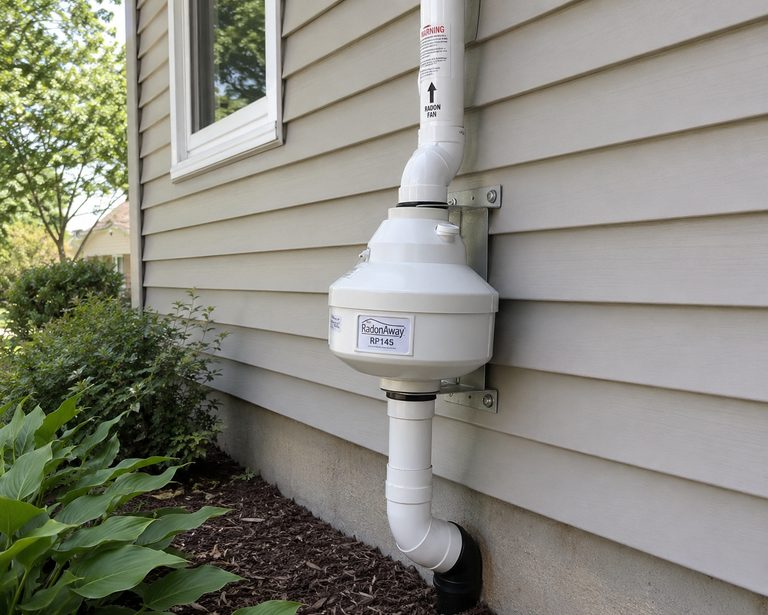
The fix recognized by the EPA for crawl space homes is sub-membrane depressurization. We install a heavy-duty vapor barrier across the entire crawl space floor, run it up the foundation walls, and seal every seam, pier, and penetration. A suction pit goes in beneath the membrane, connected by PVC to a quiet inline radon fan that runs continuously. That fan maintains negative pressure under the barrier, so soil gas is intercepted below the membrane and pushed out above your roofline instead of into your living room.
Each system comes with a sealed 20-mil reinforced vapor barrier acting as the radon membrane, sealed seams and penetrations throughout, a correctly sized and placed suction pit, a low-wattage inline radon fan rated for continuous operation, exterior PVC routed and terminated above the roofline per EPA guidance, a system monitor that shows the fan is maintaining suction, and post-installation radon testing to confirm your levels have fallen below 4 pCi/L.
If your Hermitage crawl space is still bare dirt and vented, radon mitigation and full encapsulation make sense as one project — the sealed moisture barrier and the radon membrane are the same layer. If you've already invested in encapsulation, we can add an active suction point and fan to your existing barrier rather than replacing it.
Cost is driven by crawl space size, the number of suction points needed to hold negative pressure under the membrane, whether sealing work is already done, and how the vent stack routes up the exterior. After walking your Hermitage home in person, we put the full scope and price in a free written estimate.
We inspect your Hermitage crawl space, go over any radon test results you have, and plan the right suction layout.
A clear, itemized scope and price — including any barrier or sealing work the system needs to perform.
Membrane, suction pit, PVC routing, fan, and exterior termination, installed cleanly and code-aware.
We verify radon has dropped below the EPA action level and show you how to read the system monitor.
Yes. Hermitage sits in Davidson County, an EPA Radon Zone 1 county — the highest-risk category. The limestone bedrock under east Nashville produces radon regardless of neighborhood, and homes near Percy Priest Lake and the Stones River test above the 4 pCi/L action level just as often as anywhere else in the county.
Most Hermitage subdivisions from that era were built over vented crawl spaces with loose 6-mil plastic at best. Open vents, unsealed plastic, subfloor gaps, and plumbing penetrations all give soil gas a clear path from the dirt floor into the living space above.
We seal a heavy vapor barrier across the crawl space floor and up the walls, set a suction pit beneath it, and connect a quiet inline fan that runs continuously — drawing radon out from under the membrane and exhausting it above the roofline.
Neither. Inline radon fans are low-wattage units designed for quiet continuous operation, and when mounted on an exterior wall they're typically barely noticeable from inside the home.
Not necessarily. Radon levels can vary house to house on the same Hermitage street because of differences in soil, foundation construction, and air pressure dynamics. The only way to know your number is to test your home.
We recommend both: a pre-install test to document your baseline, and a follow-up test after the fan has run continuously for at least 24 hours to confirm levels are below 4 pCi/L.
Schedule a free crawl space evaluation. We'll walk the space, review any test results you have, and give you a clear plan.
Get My Free InspectionTell us a little about your home and we'll be in touch soon to schedule a no-pressure visit.
