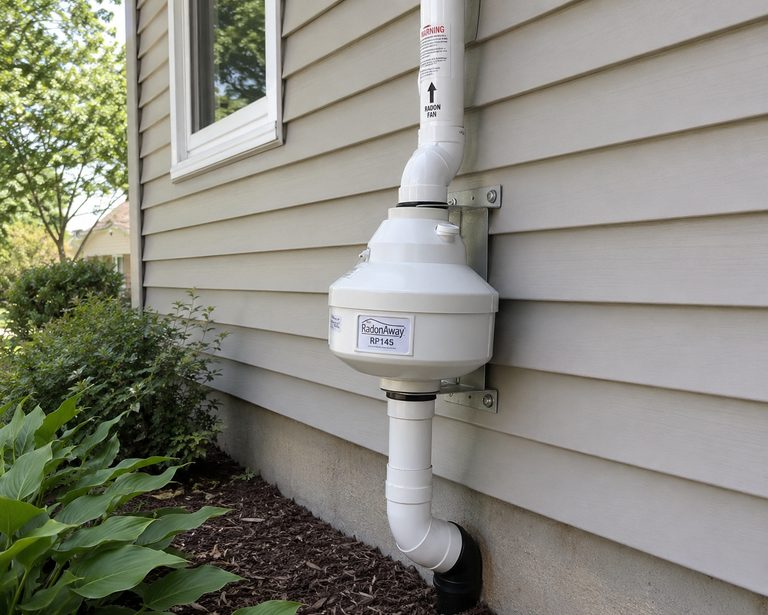
We seal the crawl space and pull radon out from beneath the barrier with a quiet inline fan — venting it above the roofline.
Rutherford County carries the EPA's Radon Zone 1 designation, the highest of three risk levels, and La Vergne's position between Percy Priest Lake and the I-24 corridor puts it squarely on the uranium-bearing limestone that produces radon across Middle Tennessee. Decades of rapid growth mean thousands of homes went up quickly over that bedrock — and speed of construction has no bearing on what the geology underneath releases. Elevated readings turn up in Lake Forest just as readily as in the city's older blocks.
The typical La Vergne starter home from the 1990s through the 2010s sits on a vented crawl space finished with the cheapest plastic the builder could buy — thin 6-mil sheeting, overlapped but never taped, never sealed to the foundation walls. Radon flows around it freely, then enters the house through subfloor seams, tub and plumbing cutouts, duct chases, and the open foundation vents. In two-story floor plans, the stack effect actively pulls crawl space air upward into bedrooms.
Sub-membrane depressurization is the EPA-recognized method for crawl space homes. We replace the loose builder plastic with a heavy-duty sealed vapor barrier covering the entire floor and running up the foundation walls, with every seam and penetration sealed. A suction pit beneath the membrane connects through PVC to a quiet inline radon fan running continuously, holding the soil side of the barrier at negative pressure and exhausting the captured gas above your roofline.
Every installation comes with a sealed 20-mil reinforced vapor barrier acting as the radon membrane, taped seams and sealed penetrations throughout, a properly dug suction pit, a low-watt inline fan rated for continuous duty, exterior PVC routed and terminated above the roofline per EPA guidance, a simple monitor so you can verify suction at a glance, and post-install radon testing to confirm the number has dropped below 4 pCi/L.
Many La Vergne crawl spaces near the lake fight humidity as well as radon. Because the radon membrane and the encapsulation moisture barrier are the same layer, doing both as one project is the most efficient path. Already encapsulated? We can add an active suction point and fan to your existing barrier without redoing the sealing work.
Your price depends on crawl space square footage, the suction layout needed to hold negative pressure under the membrane, whether sealing work already exists, and the simplest exterior route for the vent stack. We walk your La Vergne home first, then put everything in a free written estimate.
We walk your La Vergne crawl space, review any prior radon results, and determine the suction layout your home needs.
Itemized scope and price, including any barrier replacement or sealing the system requires to perform.
Membrane, suction pit, PVC routing, fan, and exterior termination — installed cleanly and code-aware.
We retest to confirm radon levels are below the EPA action level and leave you with a working system monitor.
Absolutely. Rutherford County is an EPA Radon Zone 1 county, and radon levels are set by the limestone bedrock under the home, not the year it was built. Homes in Lake Forest and the newer subdivisions off I-24 test above the 4 pCi/L action level at the same rate as older housing.
Through the crawl space. Most La Vergne starter homes from the 1990s-2010s sit on vented crawl spaces with thin builder-grade plastic that was never sealed at the seams or walls. Soil gas passes around that plastic and enters the home through subfloor gaps, plumbing penetrations, and duct chases.
Sub-membrane depressurization: a sealed heavy-duty vapor barrier across the floor and up the walls, a suction pit beneath the membrane, and a quiet inline radon fan that continuously pulls soil gas out and vents it above the roofline.
Radon tests are increasingly common in Middle Tennessee real estate transactions. If a test comes back at or above 4 pCi/L, a mitigation system is the standard remedy, and we can provide a written estimate for the negotiation.
Inline radon fans are low-wattage and built to run continuously. The added electrical cost for a typical La Vergne home is modest, and the sealed membrane reduces the moisture load on your HVAC at the same time.
Every installation includes a monitor that shows the fan is maintaining suction under the membrane, and we recommend a follow-up radon test after at least 24 hours of continuous operation — and periodic retesting every couple of years.
Schedule a free crawl space evaluation. We'll walk the space, review any test results you have, and give you a clear plan.
Get My Free InspectionTell us a little about your home and we'll be in touch soon to schedule a no-pressure visit.
