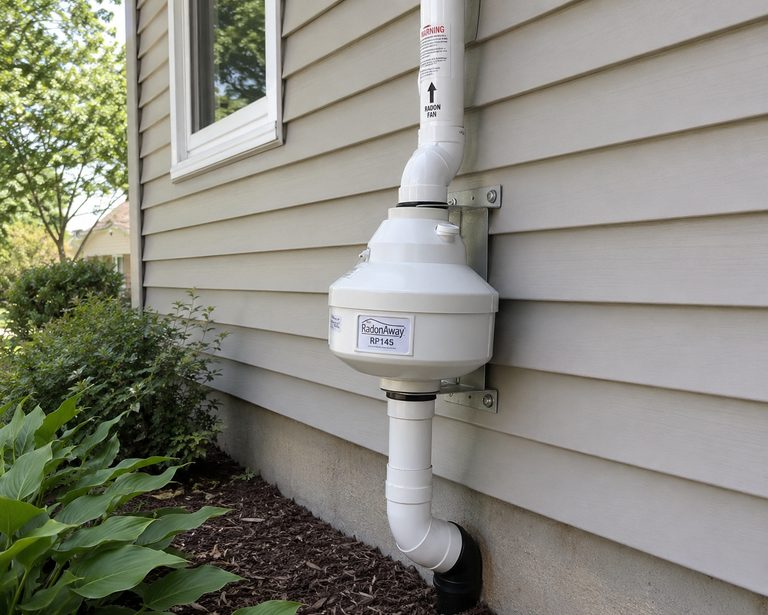
For crawl space homes, we install sub-membrane depressurization — a sealed barrier over the soil, a suction point beneath it, and a quiet fan exhausting radon above the roofline.
Rutherford County sits at the center of Middle Tennessee's Central Basin, where the Stones River has cut down through layers of uranium-bearing limestone. The EPA classifies the entire county as Radon Zone 1, its highest-risk tier. As that rock weathers and fractures, radon gas works its way up through the karst and soil — and any Murfreesboro foundation, from a 1920s bungalow near the square to a 2020s build off Blackman Road, can sit directly in its path.
Murfreesboro's housing stock is unusually mixed. Newer subdivisions lean toward slab-on-grade, where radon enters through shrinkage cracks and utility penetrations in the concrete. But a huge share of homes — especially older properties near MTSU and downtown — sit over vented dirt crawl spaces with little more than loose builder plastic on the ground. In those homes, radon rises off the exposed soil, pools under the floor, and is pulled into living areas by the house's own stack effect and ductwork.
For crawl space homes, the proven fix is sub-membrane depressurization. We install a heavy-duty vapor barrier across the entire crawl space floor, carry it up the foundation walls, and seal every seam, pier, and penetration. Beneath that membrane we set a suction point connected by PVC to a quiet inline radon fan that runs continuously, putting the soil under constant negative pressure. Radon is intercepted below the barrier and exhausted above the roofline instead of seeping into your home.
Each installation includes a sealed 20-mil reinforced vapor barrier that doubles as the radon membrane, sealed seams and penetrations throughout, a properly excavated suction pit, a continuous-duty low-watt inline fan, exterior PVC routed above the roofline per EPA guidance, a system monitor that shows the fan is maintaining vacuum, and post-install radon testing to confirm your numbers have dropped below 4 pCi/L.
Murfreesboro crawl spaces deal with the same humid Tennessee summers as the rest of the basin, and many homeowners combine radon mitigation with full encapsulation — the sealed membrane handles both soil gas and ground moisture in a single install. If your crawl space is already encapsulated, we can usually add a suction pit and fan to the barrier you have.
Cost is driven by crawl space size, the number of suction points needed to hold negative pressure under the membrane, the condition of any existing barrier, and how the vent stack routes up the exterior. After walking your Murfreesboro home in person, we provide a free written estimate with the full scope itemized.
We walk your Murfreesboro crawl space, review prior radon tests, and determine the suction layout your foundation type calls for.
Itemized scope and price, including any barrier or encapsulation work needed for the system to perform.
Membrane, suction pit, PVC routing, fan, and exterior termination — installed cleanly and code-aware.
We retest to confirm radon levels have dropped below the EPA action level and leave you with a working system monitor.
Serious enough that the EPA places all of Rutherford County in Radon Zone 1, its highest-risk classification. Murfreesboro sits on limestone bedrock that releases radon as trace uranium decays, and elevated readings turn up in every part of town — historic streets near the downtown square, established neighborhoods, and the newest Blackman-area subdivisions alike.
Yes. Crawl spaces are one of the most common radon pathways in Murfreesboro. Soil gas rises off the exposed dirt floor, collects under the house, and gets drawn up into living areas through subfloor gaps, ductwork, and plumbing penetrations — especially in older homes around the square that were built with open, vented crawl spaces.
The crawl space floor and walls are covered with a sealed heavy-duty vapor barrier, a suction point is set beneath the membrane, and a continuously running inline fan pulls soil gas from under the barrier and exhausts it above the roofline. The gas never reaches your living space.
No. Inline radon fans are engineered for quiet continuous operation, and when mounted on an exterior wall they're typically barely noticeable from inside a Murfreesboro home.
The fan draws low wattage, so the monthly impact is modest. The sealed membrane also lowers crawl space humidity, easing the load on your HVAC system, which often helps balance the difference.
We recommend both. A pre-install test confirms elevated radon and gives a baseline; a post-install test after at least 24 hours of continuous fan operation verifies levels have fallen below 4 pCi/L.
Schedule a free crawl space evaluation. We'll walk the space, review any test results you have, and give you a clear plan.
Get My Free InspectionTell us a little about your home and we'll be in touch soon to schedule a no-pressure visit.
