We install sub-membrane depressurization systems that capture soil gas beneath a sealed barrier and vent it safely above the roofline.
Nolensville transformed from a quiet historic village into one of Williamson County's fastest-growing towns in under two decades — but the geology never changed. The county sits in EPA Radon Zone 1, the highest of the agency's three risk tiers, because the limestone beneath it holds trace uranium that steadily decays into radon gas. Around the Mill Creek headwaters, that karst-prone rock is fractured and porous, giving soil gas plenty of pathways up toward foundations in every neighborhood from Burkitt Place to Bent Creek.
Most of Nolensville's housing stock was built during the boom years, and speed was the priority. The typical crawl space got a thin 6-mil sheet of builder plastic laid loose on the dirt — unsealed at the seams, unattached at the walls. That does essentially nothing against radon. Soil gas moves around the plastic, accumulates under the subfloor, and gets drawn into bedrooms and living areas through gaps around plumbing, wiring, and HVAC chases. Even tight, energy-efficient new builds can concentrate radon, because less fresh-air exchange means the gas lingers.
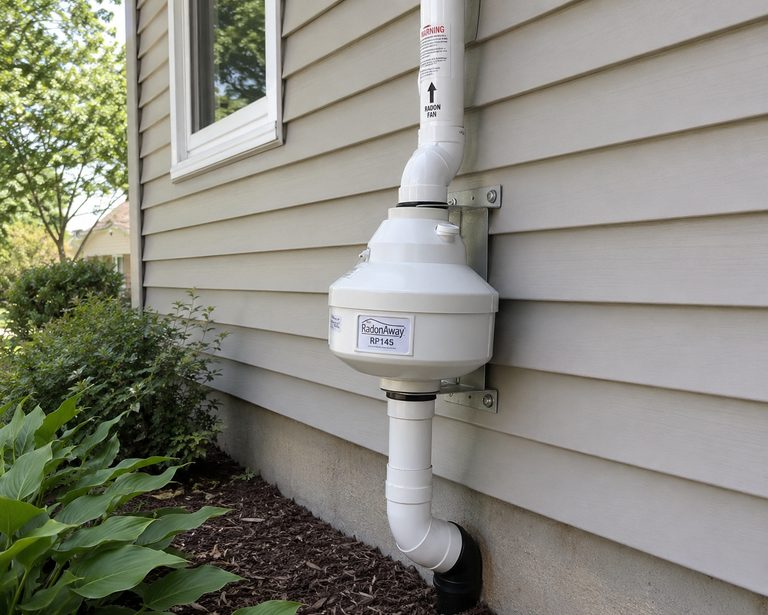
Sub-membrane depressurization is the EPA-recognized solution for crawl space foundations. We seal a heavy-duty vapor barrier over the entire crawl space floor and up the foundation walls, taping and mechanically fastening every seam and penetration. A suction point set beneath the membrane connects through PVC piping to a quiet inline radon fan running continuously. The result is constant negative pressure under the barrier: radon is intercepted at the soil and exhausted above the roofline, never reaching your living space.
We install a sealed 20-mil reinforced vapor barrier that serves as the radon membrane, seal all seams and penetrations, excavate a properly sized suction pit, mount a low-watt continuous-duty inline fan, route exterior PVC above the roofline per EPA guidance, add a system monitor so you can confirm the fan is holding vacuum, and perform post-install radon testing to verify levels have dropped below 4 pCi/L.
The membrane that stops radon is the same membrane that stops ground moisture — so if your Nolensville crawl space hasn't been encapsulated, doing both in one project is the efficient path. Homes that already have a sealed encapsulation are even easier: we retrofit a suction point and fan into the existing barrier rather than replacing it.
Pricing varies with the footprint of the crawl space, how many suction points are needed to maintain negative pressure under the membrane, whether an encapsulation is already in place, and the exterior route available for the vent stack. We walk your Nolensville home in person and put the full scope in a free written estimate.
We walk your Nolensville crawl space, review any prior radon results, and plan the suction layout your home's footprint requires.
Itemized scope and price, including any sealing or encapsulation work the system needs to perform properly.
Membrane, suction pit, PVC routing, fan, and exterior termination — installed cleanly and code-aware.
We retest to confirm radon levels have dropped below the EPA action level and leave you with a working system monitor.
Yes. Radon comes from the rock beneath the house, not the house itself. Williamson County is in EPA Radon Zone 1 — the highest-risk designation — and Nolensville's neighborhoods, most of them built between 2005 and today, sit on the same uranium-bearing limestone as the rest of the county. Elevated tests are common in Burkitt Place, Bent Creek, and the historic village alike.
Because the boom-era construction pace prioritized speed. Most Nolensville crawl spaces were finished with a thin 6-mil plastic sheet laid loosely over the dirt — unsealed at the seams and walls — which is no barrier to soil gas. Radon passes around it and rises into the home through subfloor gaps and utility penetrations.
It's the EPA-recognized method for crawl space homes. A heavy-duty vapor barrier is sealed across the floor and up the foundation walls, a suction point is placed underneath it, and a quiet inline fan runs continuously, pulling soil gas from beneath the membrane and venting it above the roofline before it can enter living space.
Rarely. Inline radon fans are designed for quiet continuous duty, and mounted on an exterior wall they're typically barely audible from inside a Nolensville home.
Very little — these are low-wattage fans built to run 24/7. And because the sealed membrane reduces crawl space humidity, your HVAC often works less, which helps offset the small added draw.
Test before installation to confirm elevated radon and set a baseline, then again after the fan has run continuously for at least 24 hours to verify levels are below 4 pCi/L.
Schedule a free crawl space evaluation. We'll walk the space, review any test results you have, and give you a clear plan.
Get My Free InspectionTell us a little about your home and we'll be in touch soon to schedule a no-pressure visit.
