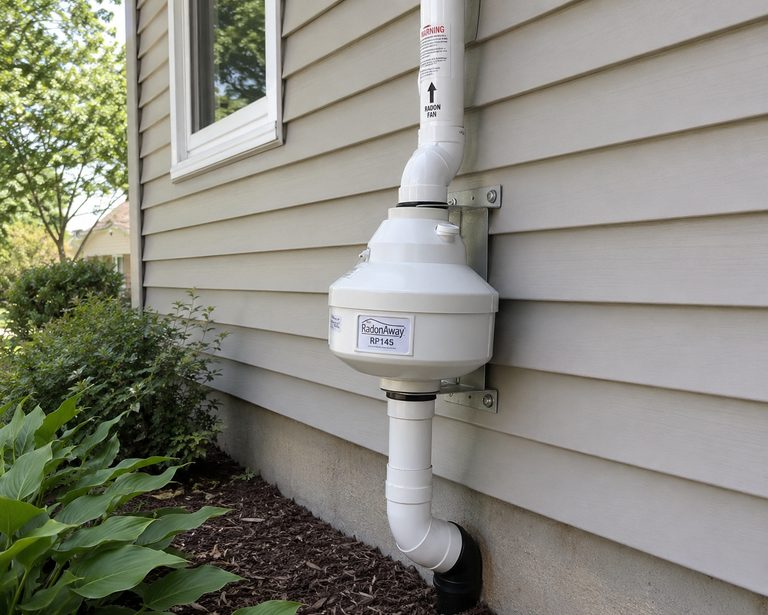
We install sub-membrane depressurization systems tailored to older foundations — a sealed barrier over the soil, a suction point beneath it, and a quiet fan venting above the roofline.
When DuPont built the Old Hickory village in the late 1910s, nobody had heard of radon — but the limestone beneath those streets has been producing it the whole time. Davidson County carries the EPA's Radon Zone 1 designation, the highest of three tiers, because trace uranium in the bedrock decays into radon gas that migrates up through fractured rock and soil. That applies along the Cumberland River bluffs, through Rayon City, and out to the newer homes around Old Hickory Lake just the same.
Old Hickory's 1910s–20s housing stock was built on pier-and-beam foundations over bare dirt, ringed with foundation vents and never intended to be sealed. A hundred years of settling has added gaps around sills, piers, and floor penetrations. With no barrier of any kind between the soil and the original hardwood floors, radon rising off the ground flows straight up into the living space — and the tall, leaky stack effect of an older two-story home actively pulls it in.
The fix is sub-membrane depressurization, adapted to the quirks of historic construction. We fit a heavy-duty vapor barrier across the entire dirt floor, cut and seal it around every pier, and carry it up the perimeter walls. A suction point beneath the membrane connects via PVC to a quiet inline radon fan running continuously, holding the soil under negative pressure so gas is captured below the barrier and vented above the roofline instead of rising into the house.
Every system includes a sealed 20-mil reinforced vapor barrier serving as the radon membrane, careful sealing at each pier and penetration, a properly placed suction pit, a low-watt inline fan rated for continuous operation, exterior PVC routed above the roofline per EPA guidance, a system monitor so you can verify the fan is pulling vacuum, and post-install radon testing to confirm levels have fallen below 4 pCi/L.
Older Old Hickory crawl spaces almost always have a moisture problem alongside the radon one — damp soil, musty floors, rusting ductwork. Encapsulation and radon mitigation share the same membrane, so combining them addresses both in a single project. If your crawl space was encapsulated previously, we can retrofit a suction point and fan to the barrier already in place.
The price depends on crawl space size and access, how many piers the membrane must be sealed around, the suction layout needed to hold negative pressure, and the exterior vent route. Village homes with tight access take more careful labor than open modern crawl spaces, which is why we quote only after walking your Old Hickory home — the written estimate is free.
We walk your Old Hickory crawl space, note pier layout and access, review prior radon tests, and plan the right suction approach.
Itemized scope and price, including any sealing or encapsulation work an older foundation needs for the system to perform.
Membrane, suction pit, PVC routing, fan, and exterior termination — installed cleanly and code-aware.
We retest to confirm radon levels have dropped below the EPA action level and leave you with a working system monitor.
Yes. Davidson County is classified EPA Radon Zone 1, the agency's highest-risk category, and Old Hickory sits on the same uranium-bearing limestone as the rest of Middle Tennessee. Elevated readings show up throughout the area — in the historic DuPont village, in Rayon City, and in newer homes near the lake.
They can be. The DuPont-era homes were built on pier-and-beam foundations over open dirt crawl spaces, with foundation vents and a century of settling gaps. There was never any barrier between the soil and the floorboards, so radon rising off the ground has a direct path into the house.
With sub-membrane depressurization. We seal a heavy-duty vapor barrier across the dirt floor, around each pier, and up the perimeter walls, then place a suction point beneath the membrane. A quiet inline fan runs continuously, drawing soil gas out from under the barrier and venting it above the roofline.
No — inline radon fans are built for quiet continuous operation. Mounted on an exterior wall with proper isolation, the fan is typically barely audible from inside, even in a plaster-walled village home.
Yes. The fan draws low wattage — comparable to a light bulb — and is wired to a dedicated exterior circuit connection as part of the installation. The monthly electricity impact is modest.
Testing. We recommend a baseline radon test before installation, then a follow-up test after the fan has run continuously for at least 24 hours to verify levels have dropped below the EPA's 4 pCi/L action level.
Schedule a free crawl space evaluation. We'll walk the space, review any test results you have, and give you a clear plan.
Get My Free InspectionTell us a little about your home and we'll be in touch soon to schedule a no-pressure visit.
